
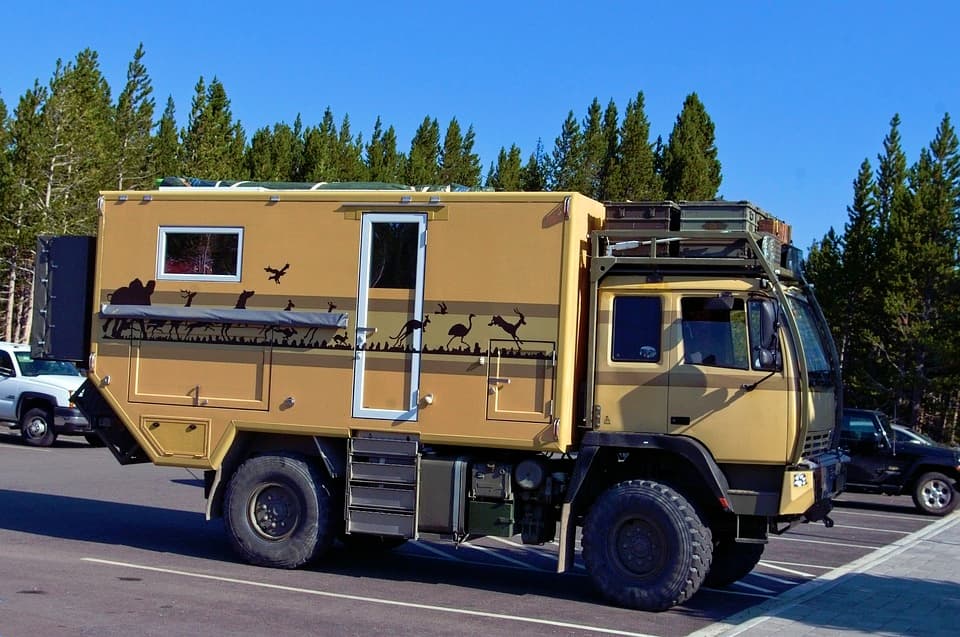
The road is the only destination. Dozens of roads, paths that diverge, of infinite possibilities. Traveling by RV has possibly been my most hedonistic dream since I was fifteen when I commented with friends that the best place to live was a motorhome because “you take it and go”, and although I don’t think I was capable of living permanently in a van (for the moment), yes that long trips with engine noise as background sound have been a constant for more than five years.
But don’t be dazzled by neon lights because traveling by van requires some organization. Going crazy is cool, but if you don’t have a certain maintenance knowledge base and a little common sense, this may not be your mode of transportation. Do you accept the challenge?
The 10 commandments to travel by RV(novice mode)
Although this guide is based on our personal experience traveling Europe, the same guide can apply if you are traveling in North and South America, especially the continental US.
1. You will plan the route in advance (even a little bit)
There are two types of travelers: planners and improvisers. Most of us poor mortals are a mix between the two. And it is that as much as we like to go on an adventure, do the camper route from Cantabria to Nordkapp and stay stranded, first, in Blaye (Bordeaux, France), then, in Turku (Finland), it is not a very positive experience …a priori.
It depends on whether your thing is to take advantage of adversity or sink into misery. In our case, it helped us to get to know a beautiful medieval town that we would never have discovered otherwise and to discover the most typical means of transport between Finnish cities.
Before traveling by camper you have to know what will happen if you experience certain vicissitudes. For now, hiring travel insurance that includes alternative accommodation just in case, can free you from having a really bad time if you have a tight budget.
2. You will respect van apps above all
The perfect van-style apps or the RV forums are going to become your best friends. Do not stop requesting information from other users and consult the areas that other users have designated as suitable for parking or camping.
3. You will not empty the gray and black water outside the spaces reserved for this effect
At this point, it should include a need that, although many vans do not perceive it when they buy a van, it is essential in cases where you are not going to stay at a campsite regularly … The need for a toilet and, if you can! , A toilet! We camper the van ourselves and if there is a purchase that we do not regret, it was the portable toilet. Yes, it may seem a bit unsanitary but when you travel a lot you discover that one of the most precious acquisitions is this.
Also, obviously, that it is the one that gives more headaches since emptying the waters implies that you have to look for emptying areas (and I do not know where you live but on the islands, it is easier to find a unicorn than an area to empty the waters outside the campsites, which are few). Our solution? Every two or three days of the journey we usually stop at a campsite to shower, dump the water, and clean the camper.
Of course, there are also gas stations and even recreational areas where there are, although it is more common in other European countries than Spain or Portugal. In short, if you want your van to travel in conditions, better get a portable toilet. You will thank me.
4. You will not camp in an urban area
Let’s see, I’ve broken this commandment so many times that I know what I’m talking about. Perhaps due to lack of foresight, such as when we stayed to spend the night in Brussels and we did not close eyes because they were partying, or when we parked on boardwalks that we thought would be quiet at night … and quite the opposite.
They even once kicked us out at four in the morning from some parking lots that were in the vicinity of the port area of Gran Canaria at four in the morning (and it is not a tasteful dish to have to look for a place to sleep half sleepy at dawn). In short, if you can avoid it, never park in an urban area.
5. You will leave 0 traces in the protected areas enabled for camping
This is supposed to go without saying, right? Well no. I’ve had to throw away the trash left by others on a few occasions. That is not to mention the van drivers who think that the sea cleans itself and dump the sewage with all the chemicals included without any shame. For the record, they are the least.
In most cases, those who leave their papers when they relieve themselves in the middle of nature are usually tourists who go by other means. Still, be careful not to disturb the surroundings. Remember that you are there on loan. You are the visitor, not the fauna and flora of the place.
6. GPS can be your best friend … or not (come on, if you travel abroad, keep turning to the map)
Let’s see. Google Maps can be an interesting tool in the city … but not if you travel on national or regional roads. Van word. If it is well signposted, it is preferable that you choose to follow these signs. Ah! And if GM invites you to go a faster route in mountainous areas, go the other way.
Surely he is sending you down the most terrible track you can imagine (I have already gone through some trouble in the La Orotava area on account of the searches for GM)
7. You will choose a trivalent, compression, or absorption refrigerator according to your needs (and not paying too much attention to your wallet)
Not all vans want (or have space) in their camper for a fridge, but on long trips, it is almost essential (unless you want to spend a month or two eating sandwiches, or you are one of those who always eat out ). We have a trivalent fridge for convenience since they are very good for long trips (it also works with both the secondary battery of the van and with gas cartridges).
Of course, if it is very hot, it will most likely not cool (they only cool down to 20-30ºC below room temperature). The compression ones are interesting for short trips since they get to cool down to -11-12ºC and they do it quickly.
8. Campsites can be your best friends
Naive of us, when we started our camper trips we did not take into account that we needed to empty the waters and shower from time to time (yes, in summer you can use a portable shower or do it on the beach but at -2ºC in Rocamadour, this option is not feasible). In some European service stations of chains such as Shell, it is possible to find showers prepared for truck drivers that have a price of $238. That is another alternative.
We also discovered that by stopping every two or three days in one, we can make a more homemade meal since we have additional space and we also rest from the road to take it harder the next day.
9. If you want to improvise, first check how much the highways cost
In our travels in Europe, we have forgotten so many times about this expense that we are already well versed in the matter. And the fact is, for example, if you want to travel from Spain to Germany, you should know that France has toll roads (if you want to know the country of France, it is only recommended to travel on national roads).
Make sure there are no ferries, pay bridges (there are quite a few in the Nordic countries, for example) as well as tolls during your trip because they can fatten the budget.
10. You will not abuse useless gadgets
In our first contact with the camper world, we got brutality of gadgets of these that are useful but that you never use. Some were really practical (such as a small gas heater), others not so much (I bought a 12v dryer. I used it once with a fairly low temperature outside. A little more, and my bangs are frosty). In the end, if you travel as a camper, you travel as a camper. If you want to be at home, opt for a bigger RV.
And here are my ten tips for traveling by camper if you start from 0. Actually, I’m sure I would think of more but now I’m not in my van so these are the novice level recommendations that you should never forget.